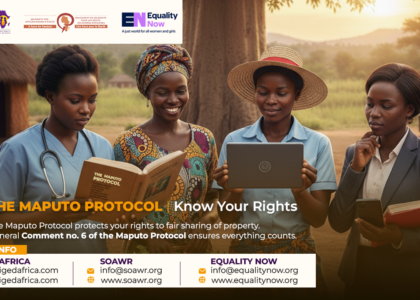
The Maputo Protocol is one of Africa’s most important regional instruments for protecting the rights of women and girls. The African Union adopted it in Maputo, Mozambique, on 11 July 2003 (African Commission on Human and Peoples’ Rights [ACHPR], 2003). It covers equality and non-discrimination, access to justice, political participation, economic rights, health, and property and inheritance.
As of March 2026, 46 AU Member States have ratified the Protocol. Nine have not: Burundi, Chad, Egypt, Eritrea, Madagascar, Niger, Somalia, Sudan and Morocco (ACHPR, 2026b). Marking the 23rd anniversary of adoption in July 2026, the Commission renewed its call on those States to ratify without delay (ACHPR, 2026a).
In this second instalment of the IGED-AFRICA Maputo Protocol Series, we look at Article 2: Elimination of Discrimination Against Women. It asks a deceptively simple question:
What does it take to make equality between women and men real?
What Article 2 requires
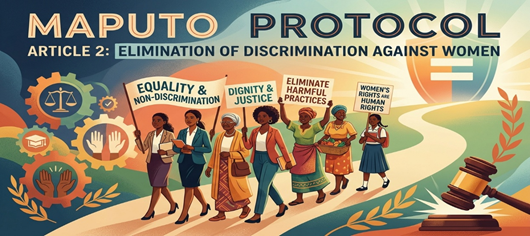
Article 2 requires States Parties to combat all forms of discrimination against women through appropriate legislative, institutional and other measures (ACHPR, 2003, art. 2). Passing a law is only the starting point. States are expected to:
- Include the principle of equality between women and men in their national constitutions and other legislative instruments, and ensure its effective application (art. 2(1)(a));
- Enact and effectively implement laws that prohibit discrimination (art. 2(1)(b));
- Integrate a gender perspective in policy decisions, legislation, development plans, programmes and all other spheres of life (art. 2(1)(c));
- Take corrective and positive action where discrimination against women continues to exist in law and in fact (art. 2(1)(d));
- Support local, national, regional and continental initiatives directed at eradicating discrimination against women (art. 2(1)(e)); and
- Work to modify the social and cultural patterns of conduct, and the stereotypes and practices, that rest on ideas of the inferiority or superiority of either sex (art. 2(2)).
This breadth matters because discrimination can exist even when a law looks neutral on paper. A country can recognise equality in its constitution while women still face unequal access to land, political office, jobs, education, justice and decision-making. The test of compliance is therefore not only “Does the law say women and men are equal? ” but also “What happens in practice?”
From formal equality to substantive equality
Formal Equality means women and men are recognised as having the same rights while Substantive Equality asks whether women can actually enjoy and exercise those rights. This is why Article 2 pairs legal reform with implementation, institutional measures, corrective action and public education.
The gap between commitment and delivery is well recognised at continental level. In a 2024 resolution, the African Commission noted the inadequate implementation and domestication of the Protocol at national level. It resolved to develop a Model Law to help States harmonise their legislation with the Protocol (ACHPR, 2024). In 2026 it called on States Parties to strengthen legislation, build effective institutions, provide adequate budgets, establish robust accountability mechanisms and engage meaningfully with women, girls and civil society (ACHPR, 2026a).
Reservations also limit accountability. Nine States have ratified with reservations to some provisions: Algeria, Cameroon, Ethiopia, Kenya, Mauritius, Namibia, the Sahrawi Arab Democratic Republic, South Africa and Uganda (ACHPR, 2026b).
What discrimination looks like in practice
More often discrimination works through laws, institutions, customs and norms that produce unequal outcomes. The following African examples show how.
1. Property and Inheritance: Ghana
Ghana has had a statutory answer to discriminatory inheritance for four decades. The Intestate Succession Law, 1985 (PNDCL 111) created, for the first time, a right for spouses to inherit from the estate (Fenrich & Higgins, 2001). Yet civil society reporting to the UN Committee on the Elimination of Discrimination against Women describes a continuing gap. Property ownership and inheritance remain regulated in practice by customary law, which tends to give men greater rights over land and housing. Many women are unaware of their legal rights (Global Initiative for Economic, Social and Cultural Rights [GI-ESCR], n.d.). The same submission records that the CEDAW Committee, in its 2014 review of Ghana, urged the State to ensure that courts, including customary courts, enforce women’s land and property rights (GI-ESCR, n.d.).
This raises the central Article 2 question: is a right meaningful if women cannot effectively exercise it? A statute does not remove the barriers of custom, awareness, cost and access to remedies.
2. Political Participation: Rwanda and Ghana
Article 2(1)(d) expressly recognises corrective and positive action. Two countries show the contrast between having such measures and lacking them.
Rwanda offers the clearest example of institutional design. Its 2003 Constitution, revised in 2015, mandates at least 30% representation of women in decision-making bodies, including both chambers of parliament (RepresentWomen, 2024). Of the 80 seats in the Chamber of Deputies, 24 are reserved for women elected through specific electoral colleges (Inter-Parliamentary Union [IPU], n.d.). Women’s representation rose from 61.3% in 2018 to 63.8% in 2024 (UN Rwanda, 2024), or 51 of 80 seats (RepresentWomen, 2024). That is the highest share of women in any national legislature in the IPU’s global ranking (RepresentWomen, 2024).
Quotas open the door, but representation alone does not resolve every barrier women face in public life. As RepresentWomen (2024) cautions, women’s representation must be read alongside the wider political context.
Ghana shows why such measures matter. Women held only about 14.6% of parliamentary seats in 2025, placing Ghana 137th worldwide (Parliament of Ghana, 2025). In response, Parliament passed the Affirmative Action (Gender Equity) Bill on 30 July 2024 (Ghana News Agency [GNA], 2024). It became Act 1121 on presidential assent in September 2024 (Ghanaian Times, 2025). The Act provides for a progressive rise in women’s representation in governance, from 30% in 2026 to 50% by 2030. It also provides for gender-responsive budgeting and mechanisms for enforcement and accountability (Parliament of Ghana, 2025). The Act is a major step, and the real test is whether the targets are met. In December 2025 the National Queen Mothers Association was still urging the government to implement it fully (Ghanaian Times, 2025).
3. A constitutional promise still unmet: Kenya
Kenya’s 2010 Constitution requires the State to take legislative and other measures so that no more than two-thirds of the members of elective or appointive bodies are of the same gender (Art. 27(8); The Standard, 2026). More than a decade on, the principle has not been realised in Parliament. After the 2022 election, women held 23% of seats in the National Assembly, below the constitutional requirement (The Standard, 2026). In 2020 the then Chief Justice called for Parliament to be dissolved over the failure, but the High Court suspended the order and little has moved since (Reuters, 2022). Lawmakers, civil society and the National Democratic Institute launched a renewed campaign in July 2026 to secure implementation before the 2027 General Election (Capital FM, 2026).
4. When laws exist but implementation lags: Malawi
The African Commission’s 2022 review of Malawi shows the same pattern. The Commission commended Malawi’s Gender Equality Act, including the rule that public service appointing authorities must appoint at least 40% and no more than 60% of either sex in any department (ACHPR, 2022, para. 62). It also welcomed electoral reforms introducing gender quotas for Members of Parliament (para. 66). Under Article 2, however, it raised three concerns:
- no indication of how awareness of gender-related legal instruments would be scaled up to the grassroots;
- gender quotas for political positions and in the private sector remaining problematic; and
- affirmative action in the civil service appearing to be hampered by patriarchal cultural values that limit women’s access to leadership (ACHPR, 2022, para. 73).
It recommended wider awareness campaigns, including in rural areas, and stronger efforts to challenge deeply rooted attitudes about women’s appointment to public and political positions (ACHPR, 2022, paras. 82–83).
The lesson across these cases: passing a law is not the same as implementing it. Implementation takes institutions, resources, public awareness, monitoring and accountability.
Where the Protocol has made a difference
The Protocol’s equality principles have been put to work. By its 20th anniversary, 38 of 55 African states had adopted laws and policies protecting adolescent girls’ right to education during pregnancy and motherhood. An ECOWAS Court decision affirmed pregnant girls’ right to education in Sierra Leone, and Article 6 of the Protocol has been used to challenge forced and child marriage across the continent (International Federation of Gynecology and Obstetrics [FIGO], 2023). These outcomes show that Article 2 is not abstract. It can reshape laws, court decisions and school policy.
Why Article 2 matters
Article 2 underpins many of the Protocol’s other rights. Discrimination affects whether a woman can inherit property, own or control land, access justice, take part in political decision-making, obtain education and healthcare, find employment, or be protected from harmful practices and violence. Non-discrimination is not an isolated issue. It cuts across almost every area of women’s rights.
What States should be doing
Article 2 points to a comprehensive approach, which can be tested through seven questions:
- Laws: Are discriminatory laws being amended or repealed?
- Policies: Do national policies reflect women’s different realities?
- Institutions: Are institutions equipped to protect and promote women’s rights?
- Implementation: Are existing laws actually enforced?
- Positive action: Are specific measures in place where historical inequalities persist?
- Education: Are governments challenging harmful stereotypes and social norms?
- Accountability: Can women effectively challenge discrimination and obtain remedies?
Where civil society comes in
Article 2 is a practical tool for advocacy and accountability. CSOs can ask which discriminatory laws remain, whether equality laws are being implemented and by whom, what resources have been allocated, and what evidence exists on women’s actual experiences. They can also ask whether institutions respond to complaints and whether policies reach women facing intersecting barriers.
State reporting is a key accountability channel. Article 26 requires States Parties to report to the African Commission every two years, yet fifteen years after the Protocol’s entry into force only 15 of 42 States Parties had reported on it. Many States submit reports under the African Charter without the part covering the Protocol, which makes progress hard to track (African Union, n.d.). The Commission has encouraged NHRIs, NGOs and CSOs to submit alternative reports and communications where women’s rights are violated (ACHPR, n.d.). Civil society shadow reports can help fill the gap.
From Article 2 to the bigger picture
Gender equality cannot be achieved through legal recognition alone. A country may have constitutional guarantees, anti-discrimination legislation and progressive policies. The question that remains is:
Are those commitments changing women’s lives?
That is the space between commitment and implementation, and governments, institutions, civil society and communities all have a role in closing it.
As the IGED-AFRICA Maputo Protocol Series continues, we will examine the Protocol article by article, linking each provision to real implementation issues affecting women and girls across Africa.
Know the provision. Understand the reality. Monitor implementation. Advocate for change.
Sources
African Commission on Human and Peoples’ Rights. (n.d.). Webinar on the soft laws of the Special Rapporteur on the Rights of Women in Africa and the domestication of the Maputo Protocol [Outcome recommendations]. https://achpr.au.int/ar/node/3791
African Commission on Human and Peoples’ Rights. (2003). Protocol to the African Charter on Human and Peoples’ Rights on the Rights of Women in Africa (Maputo Protocol). https://achpr.au.int/en/node/878
African Commission on Human and Peoples’ Rights. (2022). Concluding observations and recommendations on the 2nd and 3rd combined periodic report of the Republic of Malawi (2015–2019) and initial report under the Maputo Protocol, adopted at the 70th Ordinary Session, 23 February–9 March 2022. https://achpr.au.int/sites/default/files/files/2022-09/eng-concludingobservationsmalawi-2nd-3rd.pdf
African Commission on Human and Peoples’ Rights. (2024). Resolution for the development of a Model Law on the implementation and domestication of the Maputo Protocol, ACHPR/Res.592 (LXXX) 2024. https://achpr.au.int/sw/node/4083
African Commission on Human and Peoples’ Rights. (2026a, July 11). Press statement on the 23rd anniversary of the adoption of the Maputo Protocol. Banjul, The Gambia. https://achpr.au.int/fr/node/4632
African Commission on Human and Peoples’ Rights. (2026b). Advocacy framework on the withdrawal of reservations to the Maputo Protocol (executive summary; data as of March 2026). https://achpr.au.int/sw/node/4581
African Union. (n.d.). Accelerating the implementation of commitments to African women [Press release on the ratification, domestication and implementation of the Maputo Protocol]. https://au.int/sw/node/39613
Capital FM. (2026, July 6). Civil society, KEWOPA lead new push for two-thirds gender rule reforms. https://capitalfm.africa/civil-society-kewopa-lead-new-push-for-two-thirds-gender-rule-reforms/
Fenrich, J., & Higgins, T. E. (2001). Promise unfulfilled: Law, culture, and women’s inheritance rights in Ghana. Fordham International Law Journal, 25(2), 259. https://ir.lawnet.fordham.edu/ilj/vol25/iss2/1
Ghana News Agency. (2024, July 30). Parliament passes Affirmative Action Gender Equity Bill 2024. https://gna.org.gh/2024/07/parliament-passes-affirmative-action-gender-equity-bill-2024/
Ghanaian Times. (2025, December 22). Affirmative Action Gender Act: Queen Mothers Association urges full implementation. https://ghanaiantimes.com.gh/affirmative-action-gender-act-queen-mothers-association-urges-full-implementation/amp/
Global Initiative for Economic, Social and Cultural Rights. (n.d.). Women’s land, property and inheritance rights in Ghana [Parallel report to the UN Committee on the Elimination of Discrimination against Women].
https://gi-escr.org/images/documents/INT_CEDAW_NGO_GHA_18389_E.pdf
Inter-Parliamentary Union. (n.d.). Rwanda: Chamber of Deputies [Parline database]. https://data.ipu.org/parliament/RW/
International Federation of Gynecology and Obstetrics. (2023). Maputo at 20: Undimmed resolve; Advancing and protecting the rights of women and girls in Africa. https://figo.org/resources/figo-statements/maputo-at-20-undimmed-resolve
Parliament of Ghana. (2025, July 1). Official report: Member’s statement on gender equality (Hansard). https://www.parliament.gh/floor?dis=113
RepresentWomen. (2024). July’s parliamentary elections reaffirm Rwanda as a global leader in women’s representation. https://www.representwomen.org/july_s_parliamentary_elections_reaffirm_rwanda_as_a_global_leader_in_women_s_representation
Reuters. (2022). Kenya’s women leaders look to new president to keep his promises. Republished by The Sun (Malaysia). https://www.reuters.com/world/africa/kenyas-women-leaders-look-new-president-keep-his-promises-2022-09-14/
The Standard (Kenya). (2026, August 11). Githinji, I. Two-thirds gender rule: Will 2027 finally be the year? https://standardmedia.co.ke/business/amp/national/article/2001555015/two-thirds-gender-rule-will-2027-finally-be-the-year
UN Rwanda. (2024). Rwanda’s 2024 legislative election results: Women’s representation in the Chamber of Deputies. https://rwanda.un.org/en/node/282783