Introduction
Equality before the law matters, but women’s rights also depend on how women are treated in their homes, communities, workplaces and public institutions. A woman may hold rights on paper and still face humiliation, exploitation, banishment or violence that undermines her dignity.
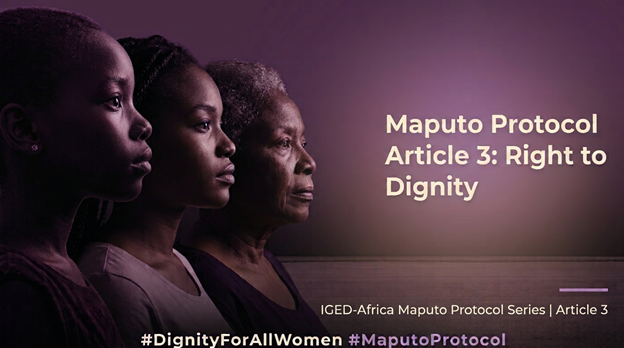
The Protocol to the African Charter on Human and Peoples’ Rights on the Rights of Women in Africa, the Maputo Protocol, addresses this in Article 3: The Right to Dignity (African Commission on Human and Peoples’ Rights [ACHPR], 2003).
Commentary from the Centre for Human Rights at the University of Pretoria notes that dignity underpins all other human rights and gives them content (Centre for Human Rights, n.d.).
This raises a practical question for African States: how can women’s dignity be protected not only in law but in everyday life?
What Article 3 provides
Article 3 has four limbs (ACHPR, 2003, art. 3):
1. Dignity and recognition of rights. Every woman has the right to the dignity inherent in being human, and to recognition and protection of her human and legal rights. Dignity does not depend on marital status, age, social position or relationships.
2. Respect as a person and free development of personality. Women are entitled to be respected as individuals and to develop their personalities freely, rather than being treated in ways that diminish their humanity or deny their agency.
3. Prohibition of exploitation and degradation. States must adopt and implement appropriate measures to prohibit any exploitation or degradation of women. This goes beyond declaring dignity a principle. It requires measures that prevent and address conduct that treats women as inferior or exploits their vulnerability.
4. Protection from violence, particularly sexual and verbal violence. States must adopt and implement appropriate measures to protect every woman’s right to respect for her dignity, and to protect women from all forms of violence, particularly sexual and verbal violence.
The Protocol defines violence broadly. It covers acts that cause or could cause physical, sexual, psychological and economic harm, including the threat of such acts and arbitrary restrictions on fundamental freedoms (ACHPR, 2003, art. 1(j)). Dignity is therefore not violated only by physical injury. Threats, degrading language, humiliation and social exclusion can also undermine a woman’s safety, autonomy and worth.
Related provisions
Article 3 works alongside other provisions that give it concrete content (ACHPR, 2003):
- Article 4 protects the rights to life, integrity and security of the person, and prohibits all forms of exploitation and of cruel, inhuman or degrading punishment and treatment.
- Article 5 requires States to prohibit and condemn harmful practices and to take legislative and other measures to eliminate them.
- Article 20(a) requires States to ensure that widows are not subjected to inhuman, humiliating or degrading treatment.
- Article 22(b) protects elderly women’s freedom from violence and their right to be treated with dignity.
- Article 25 requires appropriate remedies for any woman whose rights have been violated, and Article 26 requires States to report on measures taken and to provide budgetary and other resources for implementation.
This matters because cultural or traditional justifications cannot, by themselves, make degrading treatment acceptable. Practices must be assessed against women’s human rights and States’ obligations under the Protocol.
Connecting legal obligations to women’s experiences
1. Ghana: widowhood rites and witchcraft accusations
Ghana illustrates how the right to dignity can be put at risk by social beliefs and customary practices, and how slowly legal protection can follow.
In 2006 the UN Committee on the Elimination of Discrimination against Women (CEDAW) raised concern about discriminatory customs, including widowhood rites. It also noted the persistence of belief in witchcraft and that women accused of being witches are subjected to violence and confined in witch camps. It urged Ghana to modify or eliminate such practices (CEDAW Committee, 2006). When the Committee reviewed Ghana again in October 2014, its agenda included widowhood rites and violence against women believed to be witches (United Nations Office at Geneva, 2014).
Ghana’s delegation told the Committee in 2006 that the Criminal Code had been amended in 1998 to criminalise harmful widowhood rites and ritual servitude (United Nations, 2006).
A Parliamentary committee reported that in 2021, 539 people were living in five prominent witch camps (Gnani, Kukuo, Gushegu, Gambaga and Kpatinga). All were vulnerable people, namely older women, single mothers, widows and unmarried women (Ghanaian Times, 2023). Amnesty International’s 2025 report documented four informal camps in northern Ghana where more than 500 accused people were living in late 2023 and early 2024. It found limited access to healthcare, food, safe housing, clean water and livelihoods (Amnesty International, 2025). Amnesty interviewed 93 camp residents, including 82 women, most aged between 50 and 90 (Amnesty International Ireland, 2025). It found that accusations usually start within families or communities after an illness or death, and that older women living in poverty, with health conditions or disabilities, are at greater risk (Amnesty International, 2025). Amnesty and its coalition partners linked the pattern to the July 2020 lynching of a 90-year-old woman (Amnesty International Ireland, 2025).
In July 2023 Parliament passed the Criminal Offences (Amendment) Bill, which would make it an offence to accuse, name or label someone as a witch and would outlaw witch-finding. President Akufo-Addo withheld assent, citing constitutional concerns about the bill’s origin as a private member’s bill, and it lapsed (MyJoyOnline, 2026). Ghana’s Commission on Human Rights and Administrative Justice urged him in July 2024 to resolve those concerns and assent (Citinewsroom, 2024). In 2026 the issue is live again. Five MPs reintroduced the bill (MyJoyOnline, 2026). The Local Government Minister told Parliament in June that the government was considering adopting it (MyJoyOnline, 2026). Amnesty International Ghana had earlier appealed to President Mahama to certify it as urgent (MyJoyOnline, 2026).
These reports do not show that every widow or older woman in Ghana faces such treatment, and they do not measure how common these practices are. They do document serious violations that the right to dignity is meant to prevent.
Now, the question is whether a woman is still treated as a person with rights when she is grieving, elderly, poor or accused of wrongdoing based on community beliefs. Accusations, banishment and degrading rituals engage Article 3(3) and 3(4) directly, and Articles 20 and 22 for widows and older women. The Ghana example also shows that a law passed by Parliament protects no one until it is enacted, enforced and backed by services, education and reintegration support.
Hence, protecting dignity means challenging practices that humiliate, stigmatise or exclude women, while making sure affected women can access protection and support.
2. Kenya: widow cleansing, forced wife inheritance and the law
Kenya ratified the Maputo Protocol in 2010 (Government of Kenya, 2025, para. 144). Its experience shows how national law can address coercive practices, and where gaps remain.
Kenya’s Protection Against Domestic Violence Act, 2015, includes forced wife inheritance and widow cleansing among the acts defined as violence (ecoi.net, n.d). Widow cleansing means a bereaved wife being pressured into ritual “purification” through forced sexual intercourse, often with a relative, before she can continue her life or remarry (Equality Now & CTWOO, 2026). Such practices raise questions of autonomy, bodily integrity and the right to marry a person of one’s choice, which Article 20(c) of the Protocol protects. No woman should be compelled to undergo a ritual or enter a relationship against her will as a condition of mourning or belonging.
Equality Now and the Come Together Widows and Orphans Organization (CTWOO) argue that protections for widows in Kenya are scattered across succession, family and criminal law. They note that the Law of Succession Act, 1981, contains provisions that disadvantage widows, including a rule removing a widow’s right to her late husband’s property if she remarries (Equality Now & CTWOO, 2026). The Act does recognise wives among the dependants who can claim provision from an estate (ecoi.net, n.d, quoting section 29). In 2022 the High Court, in Ripples International Attorney General, declared certain intestate succession provisions unconstitutional for discriminating against women and girls (Government of Kenya, 2025, para. 171).
The Widowed Persons Protection Bill, 2026, was submitted to Parliament on 12 May 2026 as a private member’s bill. It would criminalise coercive mourning rites, widow inheritance, forced marriage and forced removal of children, and would create a protection board. CTWOO recorded2 139 cases in May 2026 alone (Equality Now & CTWOO, 2026). Its sponsors describe it as potentially the first dedicated widowed-persons’ rights law in Africa (Equality Now & CTWOO, 2026). It had not been enacted at the time of writing.
Kenya’s own report to the African Commission acknowledges that challenges persist in access to justice, including limited resources and the interference of “kangaroo courts”, where communities or families prefer to resolve cases such as sexual and gender-based violence on their own (Government of Kenya, 2025, para. 174). The courts have pushed back. A 2023 High Court decision declared out-of-court settlements in sexual violence cases unconstitutional (Government of Kenya, 2025, para. 164).
The existence of legal provisions does not establish that every affected woman can reach protection, or that these practices have ended. Women need to know their rights, report violations safely, and rely on police, courts and service providers equipped to respond without stigma.
Dignity requires laws that recognise women’s rights and institutions that make those rights accessible in practice.
From legal recognition to effective protection
The Ghana and Kenya examples point to a broader issue. Article 3 requires States to “adopt and implement” appropriate measures, which means more than enacting laws. In practice this includes:
- Enacting and enforcing laws: legal protections against exploitation, degradation and violence, with effective procedures for redress.
- Strengthening institutions: police, courts and public bodies that respond to complaints and treat women with respect.
- Improving access to remedies: information, safe reporting channels, legal aid and support services, including for women facing social or economic barriers.
- Addressing harmful attitudes: public education and community engagement that challenge beliefs and practices justifying humiliation, coercion or violence.
- Monitoring and resourcing: assessing whether laws change women’s experiences, and funding implementation as Article 26 requires.
The test of dignity protection lies in is whether women can exercise their rights and obtain protection and remedies when violations occur and not in the number laws passed.
Roles civil societies can play
Civil society organisations, women’s rights groups, researchers, community groups and legal aid providers are central to monitoring Article 3.
1. Documenting violations and patterns. Reliable, ethically collected information (with informed consent and safeguards for survivors’ privacy and safety) underpins both advocacy and accountability. In Ghana, the evidence base on witchcraft accusations draws heavily on civil society and human rights organisations (Amnesty International, 2025).
2. Raising awareness. Public education helps women understand their rights and where to seek help. Engagement with chiefs, religious leaders, men and young people can shift norms.
3. Monitoring laws and institutions. Organisations can track whether laws are enforced, whether complaint mechanisms work, and whether bills, such as those on witchcraft accusations in Ghana and widows’ protection in Kenya, are advancing.
4. Using accountability mechanisms. States must report to the African Commission on Maputo Protocol implementation (ACHPR, 2003, art. 26). Civil society can contribute evidence. Kenya’s latest report notes that CSOs, including Equality Now and Athena Feminists, took part in its preparation (Government of Kenya, 2025, para. 146). Independent shadow reports offer another route, as in the joint CSO shadow report on Mauritius submitted in April 2026 (Joint CSO Coalition, 2026).
5. Supporting survivors and access to justice. Where mandates allow, organisations can connect women with legal assistance, psychosocial support and shelter, and press for these services to be funded. CTWOO’s casework for widows in Kenya is an example (Equality Now & CTWOO, 2026).
Conclusion
Article 3 affirms that every woman is entitled to dignity, to respect as a person, and to protection from exploitation, degradation and violence. The experiences of older women in Ghana’s witch camps and of widows facing coercive rites in Kenya show why this matters. They also show that dignity depends on whether laws are passed and enforced, whether harmful practices are challenged, and whether women can seek justice without fear.
The question is not only whether women’s dignity is recognised in law, but whether it is respected and protected in practice.
Sources
African Commission on Human and Peoples’ Rights. (2003). Protocol to the African Charter on Human and Peoples’ Rights on the Rights of Women in Africa (Maputo Protocol). https://achpr.au.int/index.php/en/node/878
Amnesty International. (2025). Ghana: Branded for life: Witchcraft accusations and the fight for dignity in the north of Ghana. https://www.amnesty.org/en/documents/afr28/9220/2025/en/
Amnesty International. (2025, April). Branded for life: How witchcraft accusations lead to human rights violations of hundreds of women in North Ghana. https://www.amnesty.org/en/latest/research/2025/04/ghana-branded-for-life/
Amnesty International Ireland. (2025). Ghana: Hundreds accused of witchcraft urgently need protection and reparation [Press release]. https://www.amnesty.ie/?p=879767
Centre for Human Rights, University of Pretoria. (n.d.). Article 3: Right to dignity. In Commentary on the Protocol to the African Charter on Human and Peoples’ Rights on the Rights of Women in Africa. https://www.pulp.up.ac.za/edocman/pulp_commentaries/protocol_to_ACHPR/Article_3.pdf
CEDAW Committee. (2006). Concluding comments of the Committee on the Elimination of Discrimination against Women: Ghana (CEDAW/C/GHA/CO/5). United Nations. https://www.un.org/womenwatch/daw/cedaw/cedaw36/cc/Ghana/0648072E.pdf
Citinewsroom. (2024, July). Resolve issues and assent Anti-Witchcraft Bill: CHRAJ to Akufo-Addo. https://citinewsroom.com/2024/07/resolve-issues-and-assent-anti-witchcraft-bill-chraj-to-akufo-addo/
ecoi.net. (n.d.). Kenya: Domestic violence [Country information compilation on the Protection Against Domestic Violence Act, 2015]. https://www.ecoi.net/en/document/2117461.html
ecoi.net. (n.d.). Kenya: Widows, property and inheritance [Country information compilation quoting the Law of Succession Act, s. 29]. https://www.ecoi.net/en/document/2057128.html
Equality Now & Come Together Widows and Orphans Organization (CTWOO). (2026, June 23). Kenya’s Parliament urged to pass landmark bill to address discrimination against widows [Press release]. https://equalitynow.org/news/press-releases/kenyas-parliament-urged-to-pass-landmark-bill-to-address-discrimination-against-widows/
Ghanaian Times. (2023). Parliament criminalises witchcraft accusation. https://ghanaiantimes.com.gh/parliament-criminalises-witchcraft-accusation/amp/
Government of Kenya. (2025, December). 14th periodic report on the African Charter on Human and Peoples’ Rights and 2nd report on the Maputo Protocol. African Commission on Human and Peoples’ Rights. https://achpr.au.int/sites/default/files/files/2026-01/kenyas-final-14th-report-achpr-and-2nd-report-maputo-protocol.pdf
Joint CSO Coalition. (2026, April 15). Mauritius joint CSO shadow report on the implementation of the Maputo Protocol. https://youngqueeralliance.com/wp-content/uploads/2026/06/2026.04.15-Mauritius-Joint-CSO-Shadow-Report-on-the-Implementation-of-the-Maputo-Protocol-FV.pdf
MyJoyOnline. (2026, July 28). 5 MPs reintroduce Anti-Witchcraft Accusations Bill. https://www.myjoyonline.com/5-mps-reintroduce-anti-witchcraft-accusations-bill/
MyJoyOnline. (2026, July 23). Amnesty International urges Ghana to pass Anti-Witchcraft Accusations Bill six years after Akua Denteh’s death. https://www.myjoyonline.com/amnesty-international-urges-ghana-to-pass-anti-witchcraft-accusations-bill-six-years-after-akua-dentehs-death/
United Nations. (2006). Women’s Anti-Discrimination Committee commends Ghana for taking Convention obligations seriously https://unis.unvienna.org/unis/en/pressrels/2006/wom1573.html
United Nations Office at Geneva. (2014, October 20). Ghana’s record on women’s rights to face scrutiny by UN Committee [Meeting summary]. https://ungeneva.org/en/news-media/meeting-summary/2014/10/ghanas-record-womens-rights-face-scrutiny-un-committee